
Is ADHD a Motion Sickness?
There’s not an obvious connection between the two, but a small contingency of researchers and practitioners insist that the two conditions are linked.

ADHD and Motion Sickness?
There’s not an obvious connection between the two, but a small contingency of researchers and practitioners insist that the two conditions are linked.
Both conditions have bases in the cerebellum (for some more information on ADHD and the cerebellum, check out this article) and some claim that people with ADHD are more susceptible to motion sickness.

I’m skeptical, to be frank, and it’s never, ever a good idea to use medications without talking to your health care provider first. This is not advice, this is a statement about what is happening.
In ADHD 2.0, Hallowell and Ratey write about a pioneer of this approach, Dr Harold Levinson.
“His treatment protocol has been to prescribe motion sickness medications like meclizine, Dramamine, and more recently the marvelously flexible Benadryl to people with ADHD and dyslexia… It’s hard to believe [his patients] would have continued to come to him for decades were they not achieving at least some positive results.”
On Levinson’s own website is written:
“Although ADD and impaired balance/coordination and rhythm were recognized by many experts to be present in patients with Dyslexia or Learning Disabilities, Dr. Levinson was the first to discover that Dyslexia or LD and ADD all stem from one and the same inner-ear (cerebellar-vestibular) dysfunction.”
Based on a lot of other research, I’m not convinced he was first. And I’ll leave claims about dyslexia to another day (I just haven’t had time to research it). But it is an exciting and interesting area of thought.
On Reddit, one user made this connection on their own:
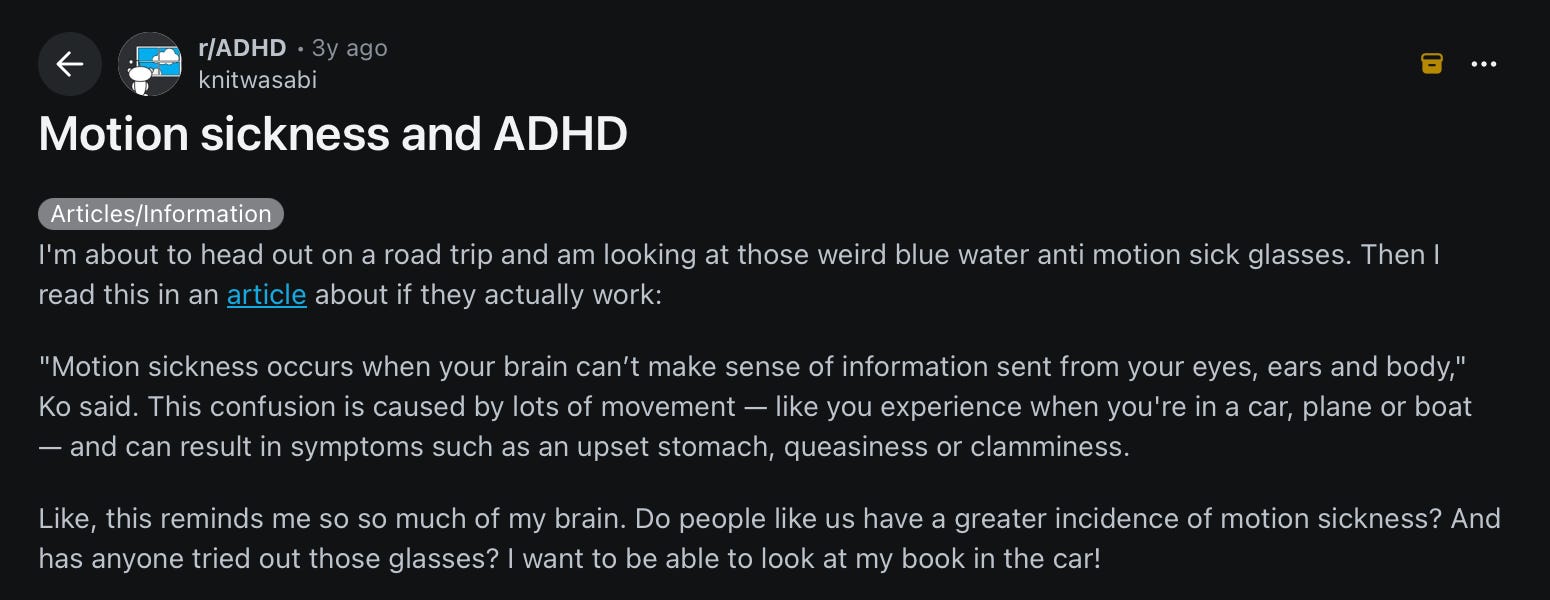
“Like, this reminds me so so much of my brain.” Them’s powerful words.
And more anecdotal evidence comes from blogger Rebecca Douglas, who wrote:
“Honestly, for much of my life, I felt landlocked, unable to cross the sea. Until something profound changed my life.
“In 2021, aged 37, I was diagnosed with ADHD. While the diagnosis in itself was life changing, the medication also cured my lifelong severe motion sickness.”
When my highly anxious dog is having a bad day I’ll give her Benadryl. Not often, just once in a while—her trazodone seems to make her aggressive to our other dog, an unfortunate but somewhat common side effect.
Benadryl is a versatile drug. But not everyone is convinced that motion sickness meds and OTC antihistamines can cure one of the world’s most common brain-based disorders.
However, all of that is just anecdotal. There is no great body of research on the subject—yet. And so, again, this is not a recommendation.
Skepticism
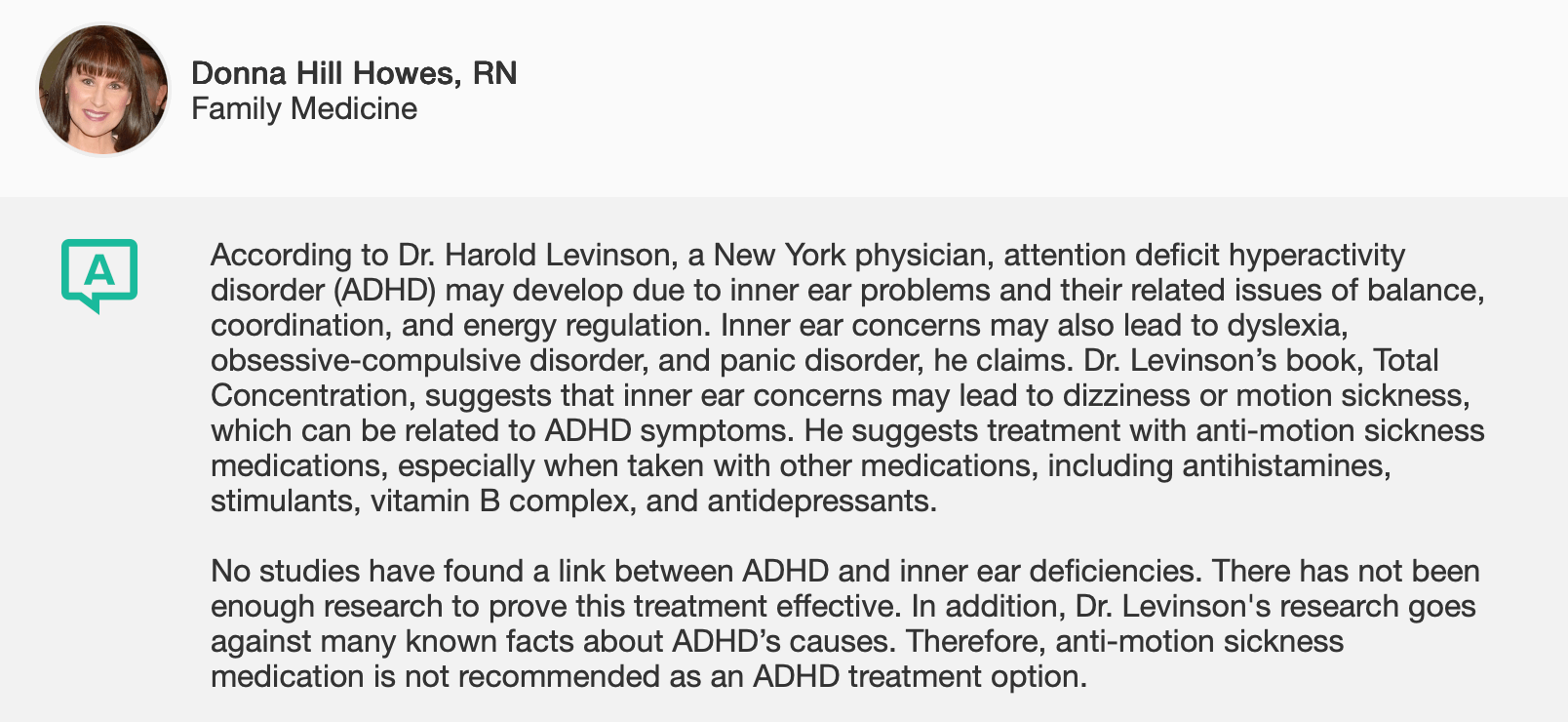
On Sharecare, a website functioning as a forum for medical professionals, Donna Hill Howes put it well: “No studies have found a link between ADHD and inner ear deficiencies.”
There is not enough data on this yet to make a ruling, but approach with caution.
Further Reading
ADHD 2.0 by Ned Hallowell and John Ratey.
DMN and TPN

The DMN and TPN are two neural networks responsible for balancing your attention span. Science does suggest that the cerebellum plays a role as a regulator.
