
DMN and TPN
Understanding Two Neural Networks at the Heart of ADHD

Default Mode and Task Positive
When you’re performing an attention-demanding task, such as digging a hole, brushing your cat, or writing a letter of complaint to the mayor, the neural network active in your brain is the Task-Positive Network or TPN. Conversely, when you are daydreaming, reminiscing, thinking ahead, wondering about your loved ones, your brain is active in its Default Mode Network, or DMN.1
“DMN activity has also been linked to ongoing spontaneous cognition or mind-wandering in general.”2
“Healthy” brains can toggle between these two networks with little trouble. An individual flipping pancakes, apparently, does not start replaying that time in history class they thought the Iron Curtain referred to the Pittsburgh Steelers. One reorganizing a bookshelf does not start daydreaming about where their next vacation might be.
People with certain disorders, among them ADHD, have more trouble toggling between these networks. Specifically, while performing a task, when the TPN should be most engaged, the DMN is humming in the background, interfering with the completion of the task.
Chapter two of ADHD 2.0 by Ned Hallowell and John Ratey provides a fantastic summary of this phenomenon.
Three Ways to Strengthen the TPN
Neurons that fire together wire together, they say. That is, the more a neuronal connection fires, the easier it fires again in the future. This is part of the brain’s amazing plasticity, and why flashcards, practice, and rehearsals all matter so much to successfully completing tasks.
So here are some recommendations to strengthen your TPN, your ability to get stuff done.
Get stuff done. I know it sounds silly, but the more you do something, the more you can do something. Set goals. Meet them. Set harder goals. Meet them. As your brain practices meeting goals, the neuronal networks capable of helping you meet those goals will become stronger.
Examples:
This comes from Kurt Vonnegut: “Write a six line poem, about anything, but rhymed… Make it as good as you possibly can.” Then, write a longer poem. Get the thing done.
Read a book. If you’re not really a reader, start small—a magazine, a comic book, a YA novel. It doesn’t really matter as long as a) it’s somewhat interesting to you and b) you finish it.
Listen to an album. All of it. Even the duller songs you don’t really like.
Draw your face in the mirror. Your whole face. Even if the sketch sucks. Just do it.
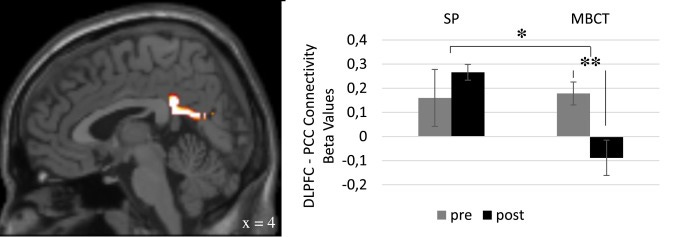
Practice mindfulness. Chou, et al., (2022) found that mindfulness based cognitive therapy helped individuals with bipolar disorder to more effectively toggle between their TPN and DMN.
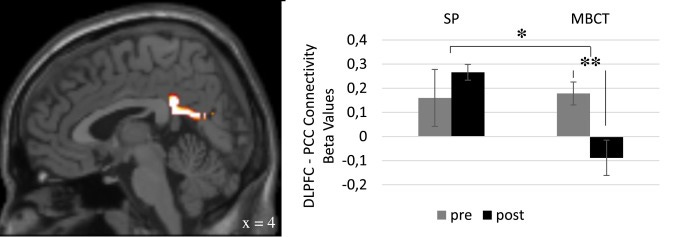
The mindfulness-based cognitive therapy group (MBCT) had better “anti-correlation” scores after intervention. This means they were more able to “shut off” their DMNs when performing a task. Please note this study was not performed on individuals with ADHD, but with bipolar disorder. To practice mindfulness, try
Redirecting your attention to the present moment in a non-judgemental way.
Sit quietly and focus on your breathing, taking deep breaths in and out.
Mindful movement such as Tai Chi could help as well
Note: patients committed to daily mindfulness for twelve weeks to see results. Sounds like another great opportunity to practice recommendation 1.
Balancing exercises. I’ll write another article about this soon, but Hallowell and Ratey also recommend practicing balance and crossing the midline as ways to strengthen the TPN—and to interrupt the DMN when you can’t seem to pull yourself out of a daydream.
Finally, do something physical. This can be a way to interrupt a daydream, or to strengthen your TPN. When I mean something physical, I mean something not digital. Manipulating physical objects in real space. For example:
Billiards, darts, or cornhole
Shoveling snow
Juggling (or learning to)
Unicycling or bicycling (or learning to)
Judo, karate, krav maga, or another martial art
Jumprope
Disc golf, shuffleboard, curling, chess, or checkers


Combined, these strategies can help you to get better at focusing, at getting stuff done, and ameliorating the distractibility holding you back.
This article includes a few affiliate links. Purchase of these items through these links won’t increase the cost to you, but will provide me with some income.
Buckner, R.L., Andrews-Hanna, J.R. and Schacter, D.L. (2008), The Brain’s Default Network. Annals of the New York Academy of Sciences, 1124: 1-38. https://doi.org/10.1196/annals.1440.011
Chou, T., Dougherty, D. D., Nierenberg, A. A., & Deckersbach, T. (2022). Restoration of default mode network and task positive network anti-correlation associated with mindfulness-based cognitive therapy for bipolar disorder. Psychiatry Research: Neuroimaging, 319, 111419. https://doi.org/10.1016/j.pscychresns.2021.111419
The contrast between the Task-Positive Network and Default Mode Network is striking. I think it highlights how crucial that toggling ability is for focus and productivity. For those with ADHD, what strategies have you found helpful in managing that balance?