
VAST vs ADHD
Respected ADHD experts coined a new term for the disorder years ago. Why hasn’t it caught on?

As I mentioned in a recent post, Drs Ned Hallowell and John Ratey proposed a new term for ADHD called VAST in 2019. VAST stands for Variable Attention Stimulus Trait. Ned credits the term to health journalist Carrie Feibel.
The first public mention of VAST seems to be a YouTube video Dr Hallowell published seven years ago. It’s short and you can watch it here. In that video, Dr Hallowell shares his hope that his upcoming book can be named VAST. That book, which the two Drs cowrote and published in 2021, is called ADHD 2.0.
In that book, VAST is described as “[ADHD]’s environmentally induced cousin,” which is not the same as renaming ADHD. But they did not stick to this definition of VAST for long.1 It seems that their focus shifted away from that definition of VAST, and instead have doubled-down on replacing ADHD with this term.
In late 2025, the term resurfaces in an ADDitude article, “ADHD Needs a Better Name. We Have One,” which Drs Hallowell and Ratey co-authored. They wrote,
“Therefore, we argue that a more accurate descriptive term is “variable attention stimulus trait” (VAST), a name that allows us to “de-medicalize” ADHD and focus instead on the huge benefits of having an ADHD brain.”

Why Change the Name?
ADHD is lousy. It emphasizes the condition’s “disorder” nature, and over emphasizes the “goldfish-brain” stereotype associated with people with ADHD.
VAST improves on this in two important ways.
1) Replacing “disorder” with “trait” suggests that the syndrome is a characteristic like blue eyes versus brown. It’s just different, not inherently worse. I certainly like that for people’s self-esteem and how they view themselves and others.
But it does undercut that there are some serious risks to having ADHD. In ADHD 2.0 Hallowell and Ratey even note the dangerous aspects of ADHD, which Russell Barkley has also detailed extensively throughout his career. Hallowell and Ratey write that an individual with ADHD has a significantly shorter lifespan due to impulsive actions. Potentially as much as thirteen years shorter.2
2) Replacing “Attention Deficit” with “Variable Attention” is much more descriptive of the actual syndrome. As anyone who is reading this article likely already knows, ADHDers’ brains don’t just flit around thing-to-thing meaninglessly. Oftentimes, ADHDers lock in on what fascinates them: art, music, math, sports, world news, etc. and become well-versed masters in that subject. Certainly, they do not lack attention. Their attention is variable.
I have to admit I don’t really know what “stimulus” is doing in there except to allow the acronym to be VAST.3 Maybe it has to do with the stimulus given to the Default Mode Network—a “neural network” that organizes attention in the brain. But I think it’s there so the word can be “VAST.”
This does seem to please people. Look at the comments on the YouTube video linked above.
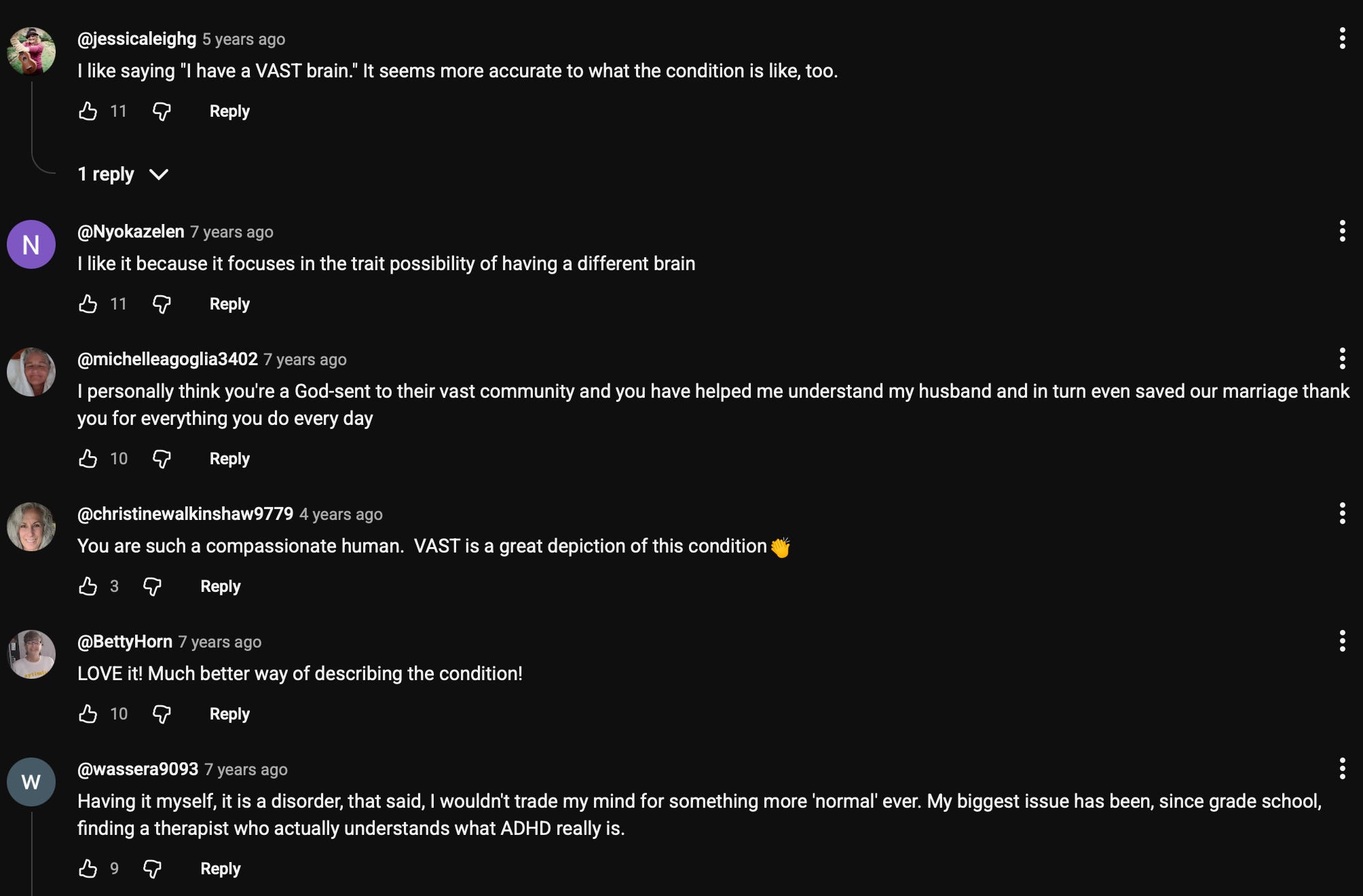
As for the H in ADHD, I could take it or leave it. Plenty of ADHDers are not really all that hyperactive, yet few never get hyperactive at all. It does feel like an infantilizing, vaguely derogatory term—“OMG you are SO hyper!!”—but I don’t think it’s all that harmful to keep. Do you?
So What?
In the six and a half years since its inception, the term has not exactly caught on.
There’s not much on the internet about VAST. A blog called VAST Diversity seems to explore ways to help people with various neurodiversities, including ADHD, but this is not an endorsement of their work.4
While I agree that ADHD is not the best name, it is important not to eschew the fact that it is very much a disorder. Keeping it medical, too, seems important to me, when for so many medications have been proven to be hugely beneficial. By de-emphasizing the medical nature of the syndrome, medicine-skeptics get more ammo to justify using non-FDA tested herbs and snake oil to “cure” something they could just be managing well with a rigorously tested stimulant.
So if you let me pick the name, and you haven’t yet, I think I would call it VAHD. Variable Attention and Hyperactivity Disorder. “Variable attention” preserves what I like best about the name change, while preserving the “hyperactivity” and “disorder.”
What do you think?
Although I wish they had. In ADHD 2.0, Hallowell and Ratey describe VAST as a condition a person gives themself through overstimulation and behavioral conditioning centered around ubiquitous smartphones and screens. “In our efforts to adapt to the speeding up of life and the projectile spewing of data splattering onto our brains all the time, we’ve had to develop new, often rather antisocial habits in order to cope.” These developed habits mimic ADHD, but are not the same thing. This definition of VAST seems to me like it speaks to so many who have used social media to self-diagnose themselves with ADHD.
“Having ADHD costs a person nearly thirteen years of life, on average.”
Fun fact! VAST is technically an acronym while ADHD is an initialism. The former can be pronounced like a word, while in the latter, each initial must be said out (like FBI, USA, PGA, LGBTQIA2S+, etc.)
Article titles include, “Overcome ADHD Decision Paralysis With This Simple Trick!” and “Bent Little Finger: A Secret Sign of ADHD or Autism?”